%20--%3e%3cdefs%3e%3cstyle%3e%20.st0%20{%20fill:%20%23ffffff;%20}%20%3c/style%3e%3c/defs%3e%3cpath%20class='st0'%20d='M676.3,451.74h78.19v31.97h-114.19v-140.37h36v108.4ZM318.72,343.34l-58.29,104.84c-1.22,2.2-3.54,3.56-6.05,3.56h-11.82v-108.4h-36v140.37h56.8c11.42,0,21.95-6.19,27.5-16.17l69.05-124.2h-41.19ZM312.61,483.71h41.19l58.35-104.95c1.22-2.2,3.54-3.56,6.05-3.56h11.82v108.51h36v-140.37h-56.86c-11.42,0-21.95,6.19-27.5,16.17l-69.05,124.2ZM908.27,470.25l50.86-91.48c1.22-2.2,3.54-3.56,6.05-3.56h11.82v108.51h36v-140.37h-56.86c-11.42,0-21.95,6.19-27.5,16.17l-49.19,88.48c-1.29,2.31-3.72,3.74-6.37,3.74h-61.13v-108.4h-36v140.37h109.43c9.51,0,18.27-5.15,22.89-13.46ZM490.32,483.71h128.5v-31.97h-92.5v-24.09h74.61v-29.43h-74.61v-23.01h92.5v-31.86h-128.5v140.37Z'/%3e%3c/svg%3e)

The memory problem
Every system remembers a slice
Every modern building runs on a constellation of systems: the building management system remembers equipment status, the maintenance system remembers tickets and asset histories, access control remembers badge swipes, the lift system remembers dispatches, the energy meter remembers kilowatt-hours, and the Vision Sensors remember occupancy and flow.
Each system remembers a slice, but none of them remember the whole. When a tenant calls about a delay or a comfort complaint, the answer might involve all six of those systems plus the weather forecast, a tenant move-in last quarter, and a configuration change a contractor made three weeks ago that no one wrote down.
A new operator joining your team takes months to build that mental map of the building, and most never get to the bottom of it. The Building AI Operator faces the same problem on day one, unless something gives it shared memory across every system that matters. That something is the Digital Twin.
The definition
A living model, not a picture
The Digital Twin is not a CAD model, not BIM, and not a holographic dashboard for an executive briefing, it is a living model of the building fused from three things.
Spatial geometry covers where things are: floors, zones, equipment locations, sensor placements, exits, and restricted areas.
Live state covers what is happening right now: occupancy per zone, equipment status, lift positions, access events, open work orders, and active alerts, all updated continuously.
History covers what has happened and how often: every sensor event, every command issued, every override, every rule change, every fault, and every report, queryable, not just stored.
The Digital Twin runs on a real-time spatial UI on the front and a cloud event store on the back, and every system that flows into VAELLA feeds into it. The result is the first place in the building's tooling where a question that crosses systems can actually be answered.
What it knows
Five categories of memory
The Digital Twin pulls together the memory the building's systems already produce, they just produce it in isolation.
It knows the spatial layout: every zone, every floor, the placement of every sensor and every piece of equipment that matters. It knows the sensing layer: Vision Sensor data on occupancy, density, flow, dwell, queues, and restricted-zone presence at the resolution of every zone you have configured.
It knows the building systems: equipment status from the building management system, lift dispatch patterns and lobby queues, and access-control events, with vertical transport being the deepest of these integrations today while the others contribute as they are connected. It knows the external context that shapes what the building does: weather forecasts, tenant calendars, holiday schedules, incident records, and lease move-in and move-out dates.
And it knows the historical archive, every event the building has produced since the Digital Twin started recording, every automated action and the override that followed, every rule change and the person who made it. The record is queryable rather than just stored, which means it is useful.
Memory makes the hire useful
What the AI operator can ask
Without memory, the Building AI Operator is an event router that sees a fault and sends an alert, useful, but limited. With memory, it can ask the questions a good operator asks:
Is this normal for a Tuesday morning? The Digital Twin compares against the last six months of Tuesday data and gives an honest answer.
How did we handle this fault last winter? The Digital Twin retrieves the previous occurrence, what was done, and how long it took.
What changed since the new tenant arrived on Floor 9? The Digital Twin shows the move-in date, the schedule changes that followed, the configuration adjustments, and the complaint pattern, all in one timeline.
Have we tried this configuration before? What happened? The Digital Twin pulls the historical record of similar setups and the operational outcomes that followed.
This is what makes the operator's recommendations grounded rather than generic, the hire is only useful if it knows the building, and the Digital Twin is what gets it there. For the hire itself, Building AI Operator, and for what the operator does with this memory when it forecasts forward, see Simulation.
When you need to see it
The 3D view, for the moments it matters
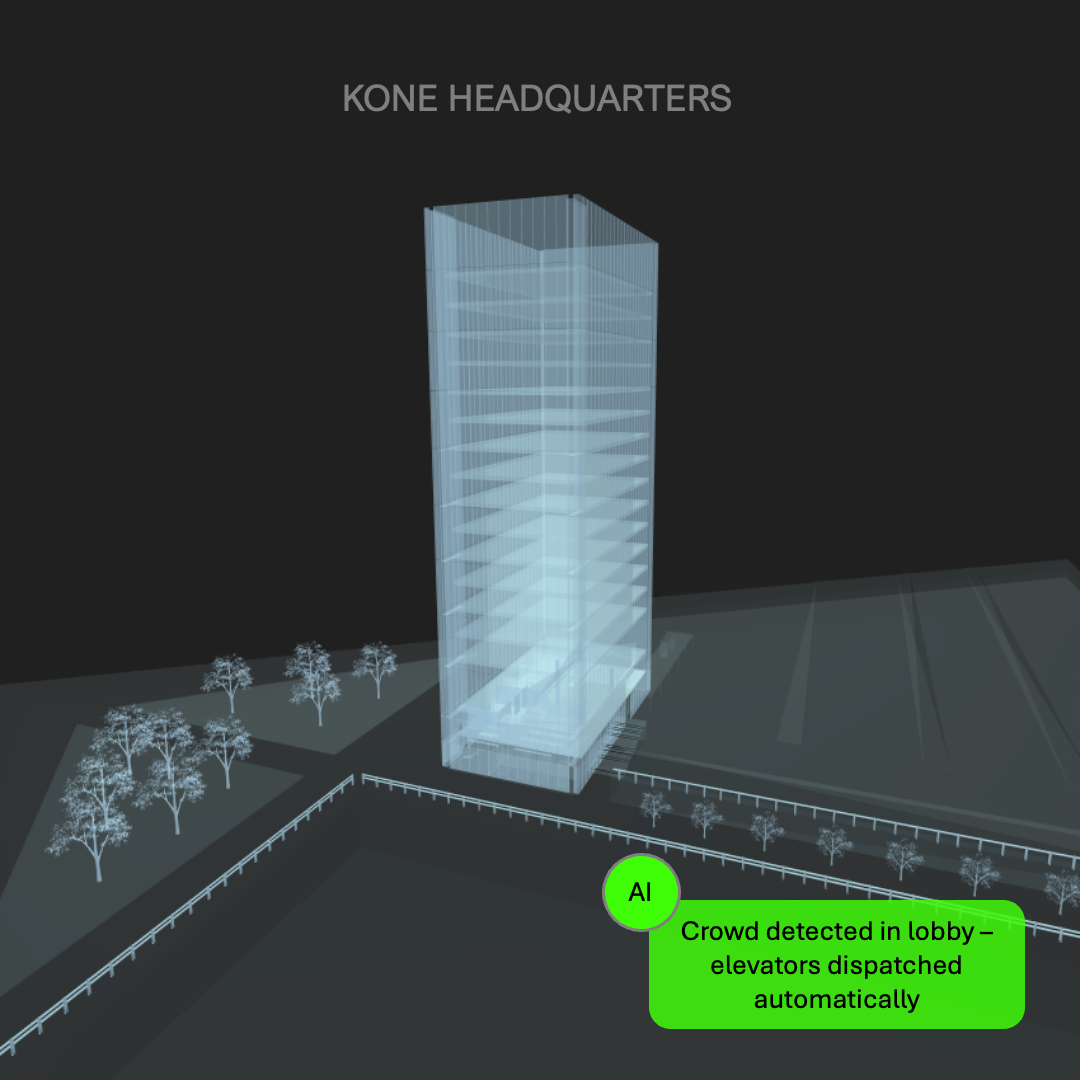
The Digital Twin has a spatial 3D view, and we are deliberate about when to use it, it is not a daily dashboard, because the team should not be staring at a 3D model of their building all day. Most of what the operator does happens in plain language in the chat tools your team already uses, and the view is for the moments when a human genuinely needs spatial context.
Those moments include investigating an incident with "where exactly did this happen, and what was around it?", briefing a contractor with "this is the zone, this is the equipment you need to reach", walking an asset manager through a building they have never visited, and reviewing a quarter's worth of flow patterns to plan a refurbishment.
When the AI Operator sends an alert into chat, the alert includes a deep-link that opens the Digital Twin focused on the right zone or piece of equipment with the surrounding geometry made semi-transparent so the relevant context is visible at a glance. The 3D view exists to put humans into context faster rather than to replace the conversation that follows.
Whose data, whose building
The Digital Twin is yours
The Digital Twin holds your building's memory, and that memory is yours.
Anonymous-by-collection upstream through Vision Sensors means there is no PII to protect downstream, because the Digital Twin holds counts, flows, equipment events, and zone-level signals rather than identities.
Tenant isolation is structural: each customer's data lives in its own partition with its own access controls and audit log, there is no shared model trained across tenants without explicit opt-in, and there is no situation where one customer's pattern leaks into another customer's recommendations.
Export is a feature rather than a favour, you can pull your data, including sensor events, equipment history, and audit logs, into your own systems at any time, and the Digital Twin is the place where the data lives most usefully rather than a place where it is held hostage.
Honest limits
What the Digital Twin is not
The Digital Twin is not BIM and is not a replacement for the CAD or project model your architects and contractors maintain, those models describe what the building was designed to be, while the Digital Twin describes what the building is doing.
The Digital Twin is not an engineering simulation of plant such as turbine dynamics, fluid flow inside pipework, or structural loads, because the focus is operational: people, equipment, throughput, and response times.
And the Digital Twin is only as good as what flows into it: a building system that is not integrated does not show up in the memory, and a maintenance platform that is not connected does not contribute to the historical archive. The first weeks of a deployment are the weeks where the Digital Twin's memory is shallowest, and also the weeks where the value compounds the fastest as more systems come online.
What's next
From memory to foresight
The Digital Twin remembers what the building has done, and Simulation runs the building forward, testing what would happen under different layouts, schedules, or operating rules, grounded in the building's own history.
For the hire that works through this memory every day, see Building AI Operator, and for the perception layer that fills the Digital Twin with people data, see Vision Sensor.