%20--%3e%3cdefs%3e%3cstyle%3e%20.st0%20{%20fill:%20%23ffffff;%20}%20%3c/style%3e%3c/defs%3e%3cpath%20class='st0'%20d='M676.3,451.74h78.19v31.97h-114.19v-140.37h36v108.4ZM318.72,343.34l-58.29,104.84c-1.22,2.2-3.54,3.56-6.05,3.56h-11.82v-108.4h-36v140.37h56.8c11.42,0,21.95-6.19,27.5-16.17l69.05-124.2h-41.19ZM312.61,483.71h41.19l58.35-104.95c1.22-2.2,3.54-3.56,6.05-3.56h11.82v108.51h36v-140.37h-56.86c-11.42,0-21.95,6.19-27.5,16.17l-69.05,124.2ZM908.27,470.25l50.86-91.48c1.22-2.2,3.54-3.56,6.05-3.56h11.82v108.51h36v-140.37h-56.86c-11.42,0-21.95,6.19-27.5,16.17l-49.19,88.48c-1.29,2.31-3.72,3.74-6.37,3.74h-61.13v-108.4h-36v140.37h109.43c9.51,0,18.27-5.15,22.89-13.46ZM490.32,483.71h128.5v-31.97h-92.5v-24.09h74.61v-29.43h-74.61v-23.01h92.5v-31.86h-128.5v140.37Z'/%3e%3c/svg%3e)

Why it exists
You cannot manage what you cannot see
Most buildings already collect a lot of data: badge swipes, equipment telemetry, ticket counts, lift dispatch logs, the occasional visitor survey. None of it answers the one question that almost every operational decision depends on: what are the people in my building doing, right now?
How busy is the lobby? Is the platform safe? Where is the queue building? Did the cafeteria empty already, so cleaning can start? Are there people in a zone that should be empty? These are the questions that drive real-time decisions, and they require a sensor that is designed to see people rather than equipment.
A CCTV wall does not answer this question without a person watching it, and a camera analytics layer answers part of it while carrying limitations the operator ends up managing. A building management system does not see people at all, it sees temperature, pressure, and valve positions. The Vision Sensor exists because the building needs a sensor designed specifically for the question you actually have.
The job
What a Vision Sensor has to do
A sensor that helps a building see people has to do six things well, all at once: count without confusion in a crowd, follow direction so the building knows where flow is heading, measure dwell so the building knows whether people are passing through or waiting, keep working when the lights change, be honest about what it cannot see, and do all of that without becoming a privacy story the operator has to defend.
That last point is where most existing options struggle. A camera does the first five things, sometimes well, but it carries a biometric capability the operator never asked for. A WiFi probe respects privacy but does not see geometry. A traditional occupancy puck counts the door, not the room. The Vision Sensor is designed around the full job, including the privacy posture.
The choice
Why vision, not cameras
The Vision Sensor senses depth by measuring distance to the surfaces around it and building a 3D map of where things are, without capturing an image at any point, no lens, no pixels, no face, no clothing.
Three properties of this approach matter for buildings:
Privacy by physics. A camera that counts crowds today can recognise faces tomorrow with modest software, because the capability is in the hardware whether or not anyone asked for it. The Vision Sensor cannot do this; it is physically incapable of producing the kind of data that biometric identification needs, which means privacy is not a policy here but an architectural fact.
Accuracy in dense crowds. When people stand close together, camera analytics struggles because bodies occlude each other and the system counts what it can see rather than what is there. The Vision Sensor works in 3D, so two people standing shoulder to shoulder are separated by a measurable gap in depth rather than by a guess from how much skin tone overlaps, and density is the case where accuracy matters most.
Reliable in any light. The Vision Sensor makes its own light with short pulses of invisible laser, which means ambient lighting, from a sunlit atrium to a dark concourse, evening floodlights, or mixed artificial sources, is irrelevant to the measurement. The same property is what makes this kind of sensing dominant in autonomous vehicles operating at night and in rain.
The product
What the Vision Sensor actually is
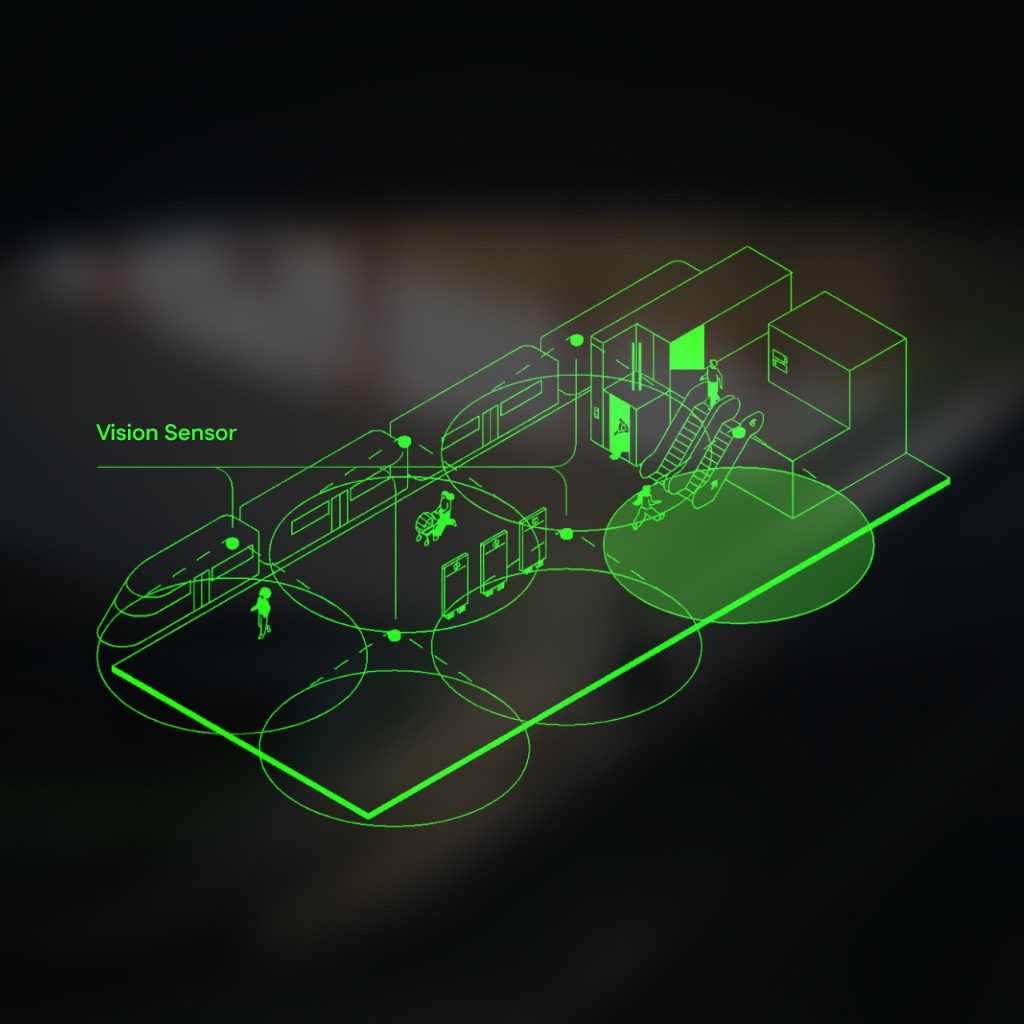
The Vision Sensor is a small ceiling-mounted sensor that looks unobtrusive and installs cleanly into a standard ceiling without needing a lens housing, a tilt mount, or a video cable.
Each Vision Sensor processes its own data on the device, and raw distance measurements never leave the unit. What each unit emits is a stream of structured events and aggregates: anonymous tracks, zone-level counts, density readings, and flow vectors, with no point cloud archive, no image archive, and no video stream.
This matters operationally as much as it matters for privacy: there is no video management system to size and license, no tape retention to manage, no Data Protection Impact Assessment marathon to schedule, and no new image archive the IT team has to defend to the DPO. The Vision Sensor produces structured data that fits neatly into the building systems you already have.
The output
The signals that leave the Vision Sensor
From a single Vision Sensor stream, the Vision Sensor produces the operational signals a building actually needs:
| Signal | What it tells you |
|---|---|
| Live occupancy | Who is where, right now, per zone |
| Density | People per square metre, with threshold alerts |
| Flow direction | How people move between zones |
| Queue length | At gates, checkouts, service points |
| Dwell time | How long people stay in each zone |
| Restricted-zone presence | Someone in a prohibited area, after hours |
These are quantified, structured signals rather than video clips that need a person to view them, and they feed straight into the next layer of the platform.
What the AI operator sees through it
Sensors are the perception layer
The Building AI Operator handles the routine work of running a building: controlling elevators, filing maintenance tickets, dispatching security, and drafting weekly reports. Without Vision Sensors it works from building telemetry alone, which tells it about valve positions, lift dispatches, and access events but nothing about people.
Vision Sensors fix that gap. With them connected, the operator can pre-position lifts before the lobby fills up, dispatch security when a restricted zone shows unexpected presence after hours, warn safety the moment density crosses a threshold on a platform, and flag crowd context alongside any equipment fault. None of these decisions are possible without seeing people first, and that is what Vision Sensors are for, they are the eyes the AI Operator works through.
The story of what the operator does with that perception lives on the Building AI Operator page.
The footprint
Coverage designed for the building
Vision Sensors deploy zone by zone rather than by catalogue, the lobbies, platforms, corridors, gates, cafeterias, gyms, meeting-room floors, and other areas where people gather are sensed, while back-of-house spaces and private offices typically are not. Coverage extends only as far as the signals you need.
A typical pilot starts with one or two zones, such as a busy lobby, a critical platform, or a high-traffic floor, and Vision Sensor data flows into the AI Operator from day one. Coverage expands as the value becomes obvious, and there is no flag-day deployment or all-or-nothing commissioning.
Limits
What the Vision Sensor does not do
Vision Sensors do not identify people and do not have the physical capability to do so; they cannot be re-purposed for face recognition, gait analysis, or any biometric task because there is no image to feed those algorithms.
Vision Sensors are not a CCTV replacement for evidentiary purposes. If a court needs video of an incident, the court needs a camera; the Vision Sensor is the right choice for operational decisions about people flow, not for legal evidence about specific individuals.
And Vision Sensors are not a black box; the data model that leaves each unit is documented, queryable, and yours. You can pull the events into your own systems, audit them, and integrate them with anything you already run.
What's next
From sensing to doing
Sensing is the foundation, and the Building AI Operator turns these signals into action, controlling elevators, dispatching security, filing tickets, and drafting reports.